Beyond the See-Saw Press: Two New Variations
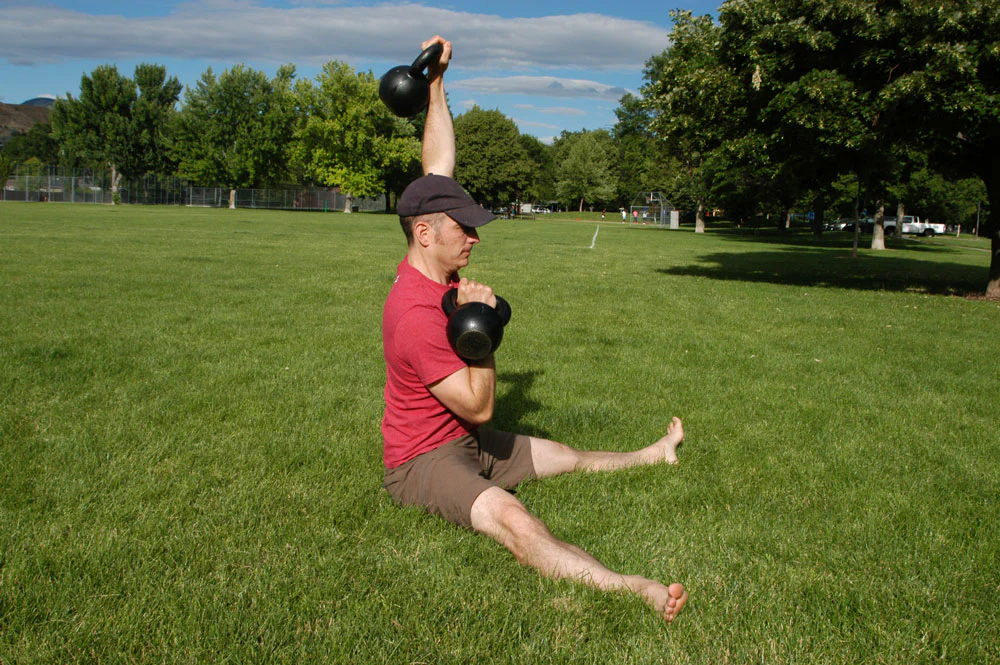
Z Saw Kettlebell Press Side view Nick Collias
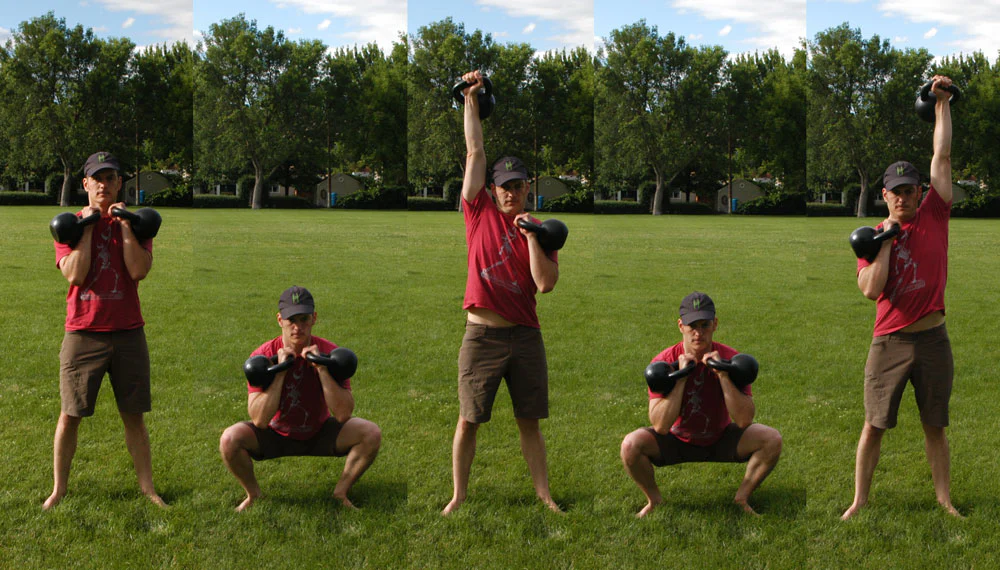
"Swollias" Kettlebell Combo Sequence Nick Collias
Source
Zurück: Rubik’s Get-Up
This website uses technical and functional cookies so everything works smoothly. If you do not agree to the use of cookies, please do not use this website.
privacy policyPlease choose your region to continue.
Some lifts just never feel quite right, no matter how hard we try to force them to do so. Others are a willing dance partner from the first rep. And from the first time I tried it, the see-saw press just felt right.
Unlike the single-arm press, which took months (er, years) to share the ideal groove, the see-saw offered it up instantly. And because it’s a rhythmic push with a bit of a pull (or an eccentric push that feels like a pull), it demands that all manner of anterior, posterior, lateral, and deep core muscles get in the game of tug-o-war. Any experienced RKC can tell you that this extra activation usually allows you to get 2-3 extra reps, maybe more, with any given weight than what you’d manage with either single-arm or double-arm presses.
That translates to extra strength, extra volume, extra activation, and extra-efficient training. Extra awesome.
Those are all reasons to try the see-saw press. But they’re also reasons to explore different variations of the movement. Here are two variations that have quickly become my two favorite presses, period.
To be clear, I make no claim to inventing either of them. Somebody else probably did long ago. I just happened across them in my training, picked them up, and am now passing them along.
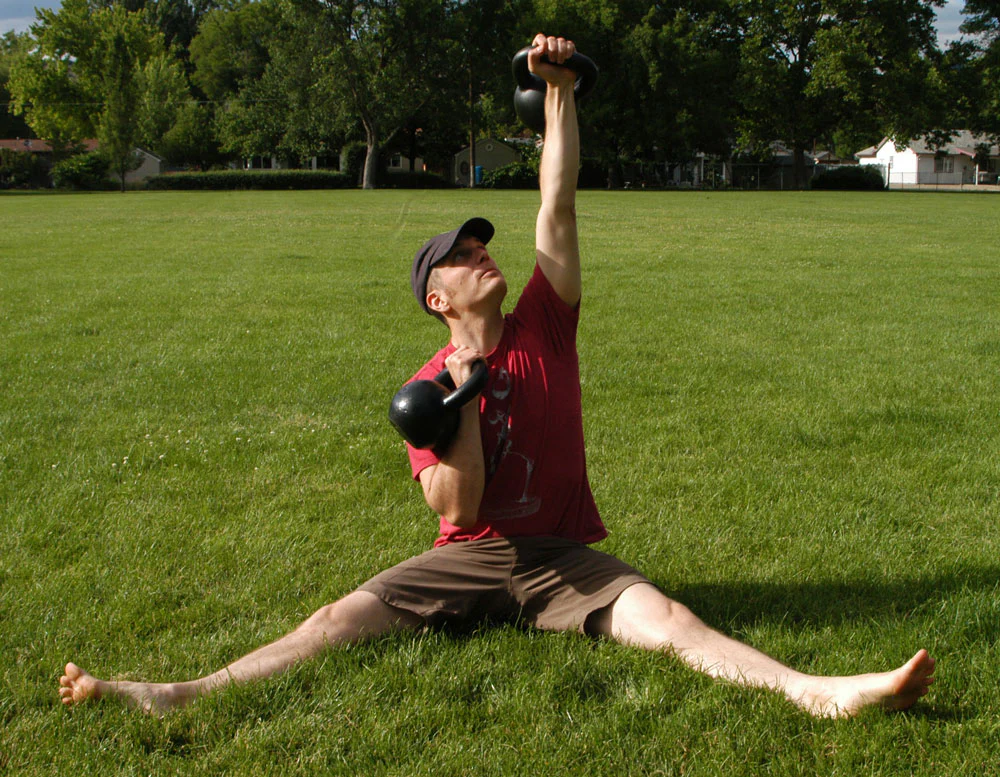
Z-Saw Press
This is nothing more than a seated see-saw press in a straddle position, or what is known as a Z-press. But that alteration changes the lift dramatically.
What I dig about it:
This is one reason why I like it with a DeLorme Protocol-style approach:
10 reps light, or around half of 10RM
10 reps medium, or about .75 of 10RM
10 reps with more or less a 10RM
Look forward or look up; either way, your postural muscles and pressing muscles will both work overtime.
Keeping a set at a 10RM or lighter also keeps you from having to figure out how to get two seriously heavy bells into position. Just curl it up and go.
One more technique note: In a recent email, Master RKC Andrea Du Cane mentioned that she recommends most people—men in particular—sit on a yoga block or something similar during Z-press variations, because otherwise they often struggle achieve a neutral pelvis and spine position on the ground. Me, I like something about half to two-thirds yoga block-height, like one of those hardcover college textbooks you haven’t done anything with in a long time. The Modern Library edition of Plutarch’s Lives of the Noble Greeks and Romans is just about perfect.
Swollias Press
This movement took on my nickname at work (I do work at Bodybuilding.com, after all), simply because I’d never seen it before, and the nomenclature alternatives are all pretty complicated. “Alternating see-saw kettlebell thruster,” anyone? No thanks. Let’s go with Swollias.
As with the Z-saw, this isn’t a new lift so much as it is a combination of existing ones. Here’s how to do it:
What’s the advantage? Well, having a bell in the rack means you’re forced to keep an upright torso and tight core. I like the single-kettlebell thruster, but find it can get a little sloppy and forward-leaning under fatigue. This variation holds a little firmer, in my experience.
Lots of cleans, lots of squats, lots of time in the rack. What more do you want?
On the flipside, it doesn’t require the same level of thoracic mobility as a double-kettlebell press or thruster, and once again, lumbar hyperextension is hard to slip into with this variation. Definitely not so with the double kettlebells.
With heaver weight, I like to treat these as a little mini-complex, kind of like Dan John’s “Armor-building” complex of two cleans, one press, and three squats. One round of clean, squat, press, clean (optional), squat, press every 30 seconds, or on the minute, is a great routine. Do it for 10-20 minutes, and it adds up to lots of cleans, lots of squats, lots of time in the rack.
Alternately, you could use a lighter weight, up the reps, and just see what cries “Uncle” first.
How To Use These Lifts
There’s a time to train like you’re chasing something—say, a half-bodyweight press for an RKC-II certification—and there’s a time to train like you’re not. And when I’m not chasing, I like to mix my presses up. A lot.
For the last few months, my favorite way to do this is to use Dan John’s press and suspension strap circuit from this article on Bodybuilding.com as a template, and swap out press variations based on whatever feels good that day. Both of these press variations have been regulars in the batting order.
Don’t confuse this with “program hopping,” that oft-maligned symptom of exercise ADD. The parameters and the basic movement patterns don’t change much; just the specifics do. If I want to change every workout, fine. If I want to do the same thing for three weeks, fine.
This approach keeps me excited to train, allows me to sneak into moderate rep PRs regularly, but also allows—or maybe forces—me to learn and explore new lifts, either those that I see out in the world, or that I cook up on my own in a moment of living room inspiration. These are two of the latter. Enjoy!
This article was originally published on dragondoor.com and is republished here with the kind permission of Dragon Door.
Original URL: https://dragondoor.com/blogs/blog/beyond-the-see-saw-press-two-new-variations