This website uses technical and functional cookies so everything works smoothly. If you do not agree to the use of cookies, please do not use this website.
privacy policyPlease choose your region to continue.
“What sets and reps should I use to make progress on my TGU?”
This is one of the most common questions about programming kettlebell training. Finding the right scheme of sets and reps is especially challenging because the get-up doesn’t follow the same rules as any other exercise in the gym. Because a single repetition of the TGU can take roughly 30-seconds, doing “5 sets of 10” simply doesn’t make sense.
Below are a few of the strategies that I’ve found to be effective for adding the TGU into your strength training program.
1. The “3-Week Wave Cycle”
This first option is intended for intermediate to advanced kettlebell lifters, and it’s my favorite way to use the get-up as a “main lift.” In other words, this option will treat the TGU as a primary exercise. Make sure that you’re relatively fresh in your workout (I would recommend doing get-ups first), leave plenty of time, and don’t plan to do an excessive amount of assistance work afterwards. Simply put, this progression WILL produce PRs.
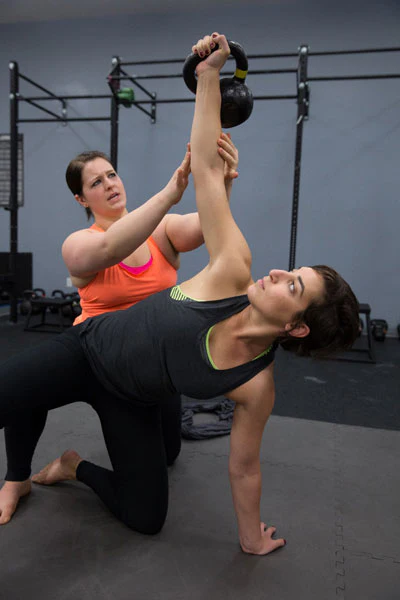
Do get-ups once per week, according to the following loading scheme:
Here’s an example of how this program might look over a few months. In this example, the athlete’s previous personal record for the TGU is a 40kg kettlebell:
2. The TGU as a Warm-Up
Simply perform 3-5 get-ups with a light-medium kettlebell (~50% of your best-ever get-up) before your scheduled workout. This is a great option if you’re working on a more involved bodyweight or barbell program, and don’t have the bandwidth or desire to fit a lot of get-ups into your program. This option also emphasizes the idea that the get-up is not just training, but also assessment.
A note on the get-up as assessment: While we use the TGU as a stimulus for adaptation, the TGU also has a useful role as a form of assessment. By mindfully practicing the get-up and noticing where the challenges are and how they evolve, you can gain important insights into the quality of your movement. For example, if I’m in a heavy powerlifting cycle involving high-volume bench pressing, and the “low sweep” of my get-up starts becoming challenged, I might conclude that my pectoral muscles have become tight, and that I need to spend some time mobilizing my overhead position.
3. 10-15 Minute Practice Blocks
Simply set a timer for 10-15 minutes and practice the TGU until the time is up.
This is our preferred way to teach the get-up to novices in a personal training or semi-private training scenario. While this program works great for those working with a coach or trainer, it’s also an excellent option for self-coached kettlebell lifters. When learning, it can be useful to remove the pressure of hitting a certain weight or number of reps, and let the athlete simply explore the movement and work on technique. We usually program this towards the end of a training session.
4. 10-15 Minute Work Capacity Blocks
This option uses exactly the same parameters are #3, except with a different purpose. Now, the goal is to perform as many get-ups as possible within the time interval, while never sacrificing quality for quantity. Record your results, and look to improve each week. This is a great option for losing weight while also improving movement quality, or for conditioning and building work-capacity.
An appropriate weight for this option is anywhere from 50-75% of your best get-up.
****
This article was originally published on dragondoor.com and is republished here with the kind permission of Dragon Door.
Original URL: https://dragondoor.com/blogs/blog/programming-the-tgu