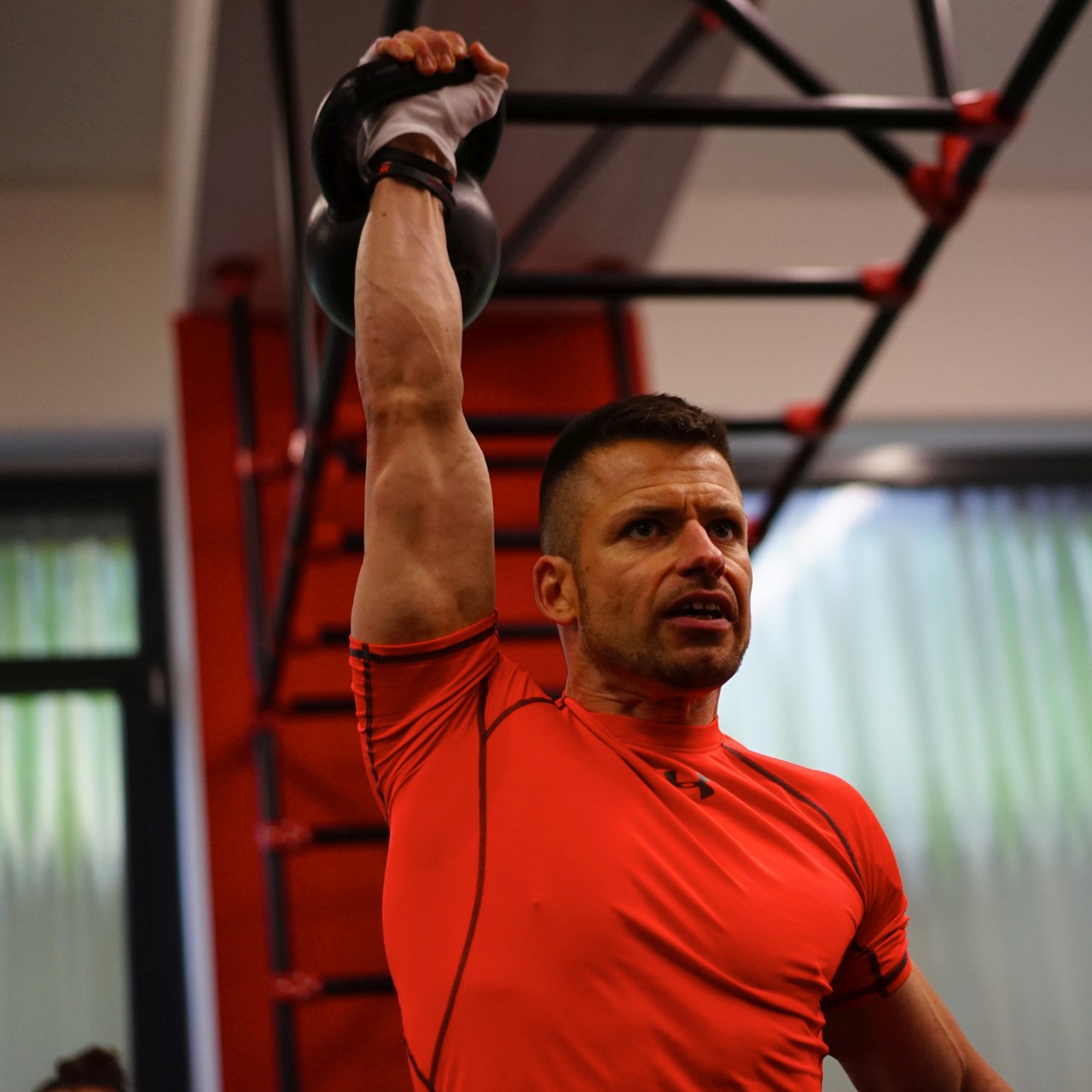
Whether you're chopping wood, carrying a child in your arms, or holding a suitcase in your hand. Whether you're running, playing soccer, or golfing: asymmetric loads are not the exception, but the rule. So if you perceive the term functional training as a practical training that provides you with a healthy foundation for sports and daily life, you should pay attention to this fact when designing your training. You have - hopefully - long since said goodbye to training machines and have moved on to free weights: kettlebells are the universal tool for that.
Ideally, you started kettlebell training with an ETKB seminar, so you master two-arm swings, goblet squats, and the Turkish get-up.
It's time to incorporate offset exercises into your training.
Why? By now, you appreciate a stable core. But that's only part of the truth because - you remember - most loads do not act symmetrically on the body.
Fortunately, kettlebells are a great training tool in this regard, which you can use for a huge variety of offset exercises.
Isn't the Turkish get-up enough? Sure: the "classic" TGU is asymmetric, but for additional training stimuli, I would complement it with more static and ballistic exercises.
Let's stay with the static: carrying exercises are ideal companions for everything that has to do with asymmetry in movement. The trio of waiter's walk, rack carry, and farmer's walk is suitable as a finisher at the end of a training session. You will be surprised at how strenuous it can be to carry the kettlebell around at first.
Many colleagues work their way up to heavier kettlebells for the military press with the waiter's walk (overhead position). If lifting (still) doesn't work, holding and lowering does.
My tip: combine the three exercises by working from top to bottom. First waiter's walk, then rack carry, and finally farmer's walk. After each exercise, switch sides.
As with the grinds, you also benefit from asymmetry in ballistic exercises.
One-arm swings are the next logical step after two-arm swings.
A kettlebell that acts unilaterally dynamically puts a good strain on shoulder muscles, diagonal abdominal, and back muscles. I'm talking about those muscles responsible for the rotation of the upper body or for preventing forced rotation. My tip: before you invest in a larger kettlebell, first train one-arm swings.