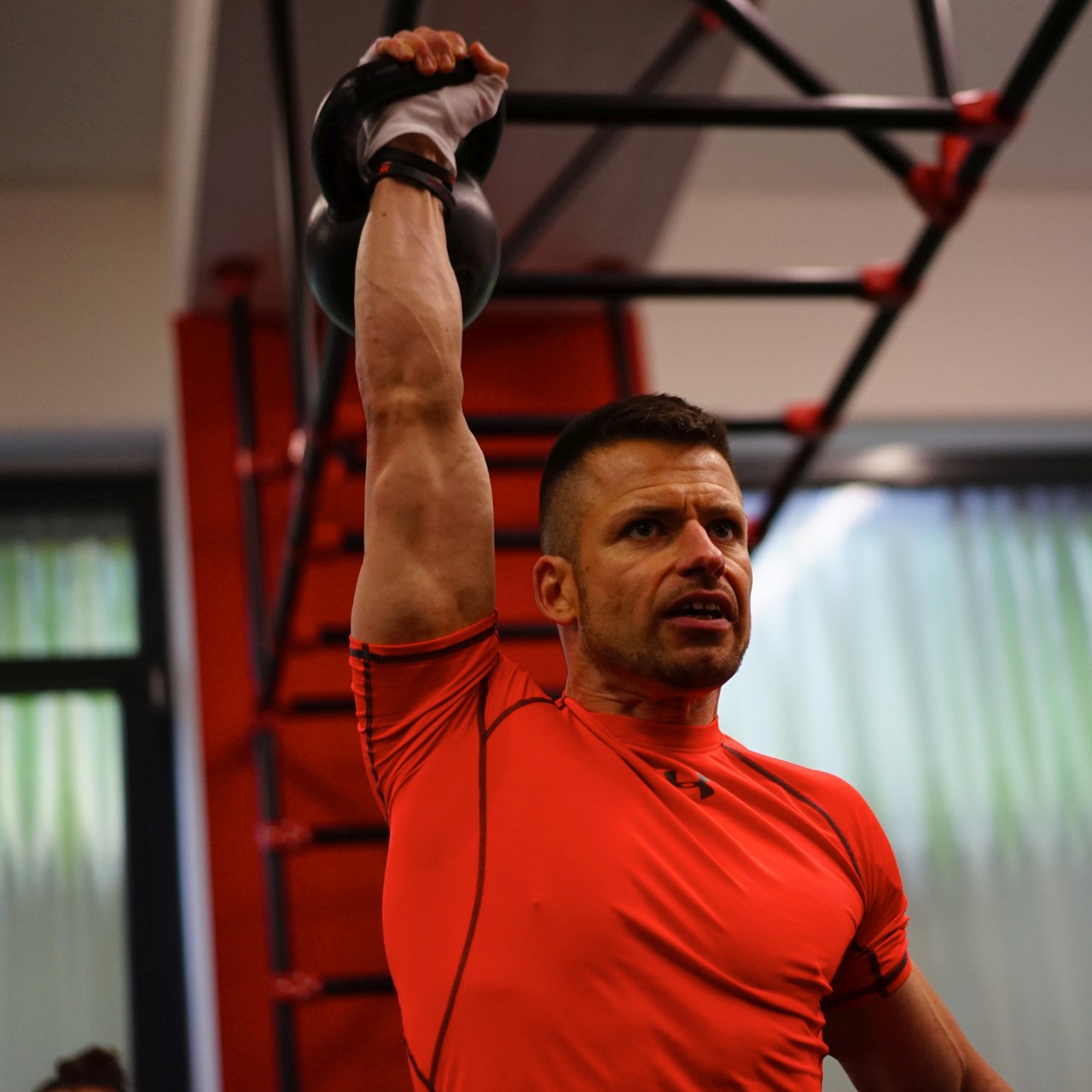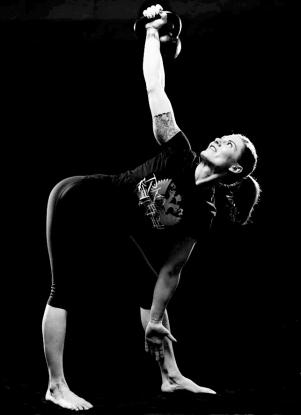
The Windmill is a wonderfully effective exercise when it is not misunderstood and the ego can be dialed back. As a so-called "loaded stretching" exercise - stretching with additional weight - it is primarily not about touching the ground with as much weight as possible overhead and with the free hand. It's great if you can do it and have the mobility, but this ability must first be developed. Rather, it is about achieving a broad hip hinge while simultaneously achieving as much rotation of the thoracic spine as possible, without giving up the stabilization of the spine. Not so easy, especially when it also means holding a kettlebell securely overhead.
Before attempting the Windmill, the TGU should be stable. One should be able to stabilize the spine in a neutral position, maintain a firm grip on the shoulders, and keep the elbow fully extended in a straight lockout position.
When performed correctly, the Windmill strengthens the core muscles, mobilizes and stabilizes the shoulder joint, increases the rotational capacity of the thoracic spine, and flexibility in the hips, adductors, hamstrings, and IT band. Ultimately, it leads to an improvement in body control and overall coordination. Many reasons therefore speak in favor of occasionally incorporating this exercise into the training plan.
Brief description of the process: The kettlebell is brought overhead with the right arm via Military Press or Snatch. Stand with feet hip- to shoulder-width apart. Both toes rotate to the left (45° left / 30° right). Hip flexion: the hip pushes back as far as possible, in line with the feet - while simultaneously rotating the spine. The right leg is straight, and 80% of the body weight is on it. The left leg is slightly bent, and the left hand moves with the back of the hand from the inside of the thigh, over the knee to the inside of the calf, down to the ground. The upward movement is initiated by the right hip moving forward. At the same time, the upper body straightens up again.
The arm holding the kettlebell remains fully extended throughout the entire movement, and the humeral head is firmly fixed in the shoulder joint by muscle. Attention, the wrist must also be stabilized straight! Since this exercise involves a very complex movement pattern, it should first be executed safely without additional weight.
A high-quality movement provides you with lasting greater benefits!