The gluteal muscles are a key factor for good core stability, as they play a significant role in a physiological pelvic position. However, in our "sitting society," there is often a gluteal amnesia, meaning a lack of activation of the gluteal muscles. This can be the cause of many musculoskeletal problems, such as back pain. Training from the half-kneeling position can counteract this, as it demands core stability while simplifying it compared to standing positions and addressing asymmetries.
Position Description:
- Lunge position
- Hip of the front leg is bent unilaterally, knee joint forms a 90° angle, foot is completely flat
- Hip of the back leg is extended, knee bent at 90°, knee is in contact with the ground, foot is positioned so that toes and ball of the foot touch the ground
- Glutes are engaged
- Neutral spine position
- Shoulders are relaxed and away from the ears
- Gaze is forward
The focus is on stabilizing the core. Important for this is the engagement of the gluteal muscles and an upright pelvic position as a result. The pelvis does not tilt to one side.
Hip Flexor Stretch
From the half-kneeling position, the hip flexor of the back leg can be wonderfully stretched. For this, the pelvis must be pushed forward. It is important to maintain tension in the gluteal muscles of the back leg. When done correctly, a noticeable stretch can be felt on the front of the back leg.
Standing Up and Sitting Down
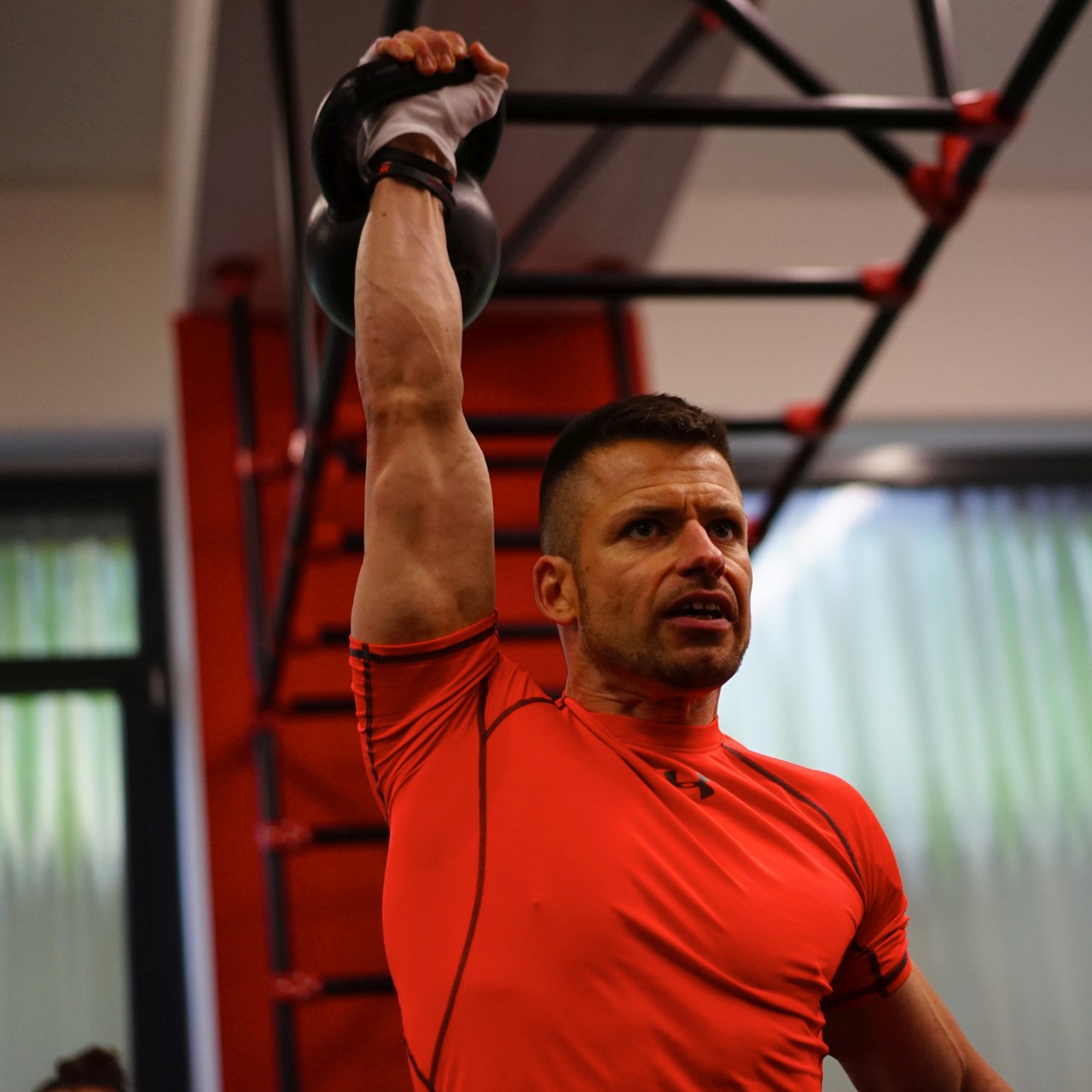
Standing up from the half-kneeling position is a fundamental movement. The upper body is upright, which can be checked by allowing the arms to hang loosely during the movement. When done correctly, the forearms should be next to the hip joints in both the starting and ending positions. The gluteal muscles must be strongly engaged on both sides while standing to avoid hyperextension in the lumbar spine. Initially, controlled standing up and sitting down should be practiced with body weight. The exercise can then be made more challenging with kettlebells in various holding positions.
Pulling and Pushing Patterns
In the half-kneeling position, almost all pulling and pushing patterns can be performed in the movement directions. Unilateral patterns particularly demand a holistic core stability.
The combination of exercise options from the half-kneeling position is an excellent movement routine.