The fascia hype is criticized from many sides, yet the fascia is not a new invention. So how is it that it has received so little attention for so long? Probably because it was only seen as filler material. However, it was already recognized in yoga and later in Rolfing and osteopathy that a healthy fascial body leads to a pain-free life and youthful mobility.
Every sport is fascia training
The fascia, colloquially referred to as connective tissue, essentially connects all functional units of our body with each other. For example, it connects muscle cells with bone cells and, through the joints, muscles with other muscles into muscle chains. The muscle fascia (myofascia) surrounds the muscle cells with fine collagenous membranes, which at the ends of the muscle cells become fiber bundles that we then refer to as tendons, anchoring the muscle fiber bundles to the bone. Thus, with every muscle contraction, tension is created on these fiber bundles, effectively training the muscle fascia!
Does every sport positively affect the muscle fascia equally?
First of all, nearly every type of movement has a more positive effect on the fascia than no movement at all. Nevertheless, there are enormous differences. Here, one must refer to the ability of the muscle fascia to store and release energy. This can be explained with the catapult effect. When a catapult is drawn back, kinetic energy is stored. When the arrow is released, this energy is released again. The simple stretch-shortening reflex of muscle cells does not explain the release of this energy. The length difference between a contracted and a stretched muscle cell is limited. Any additional stretching occurs from the muscle fascia, which acts similarly to a rubber band. We can imagine that a brittle old rubber band releases correspondingly less kinetic energy than a fresh new rubber band.
Ballistic kettlebell exercises
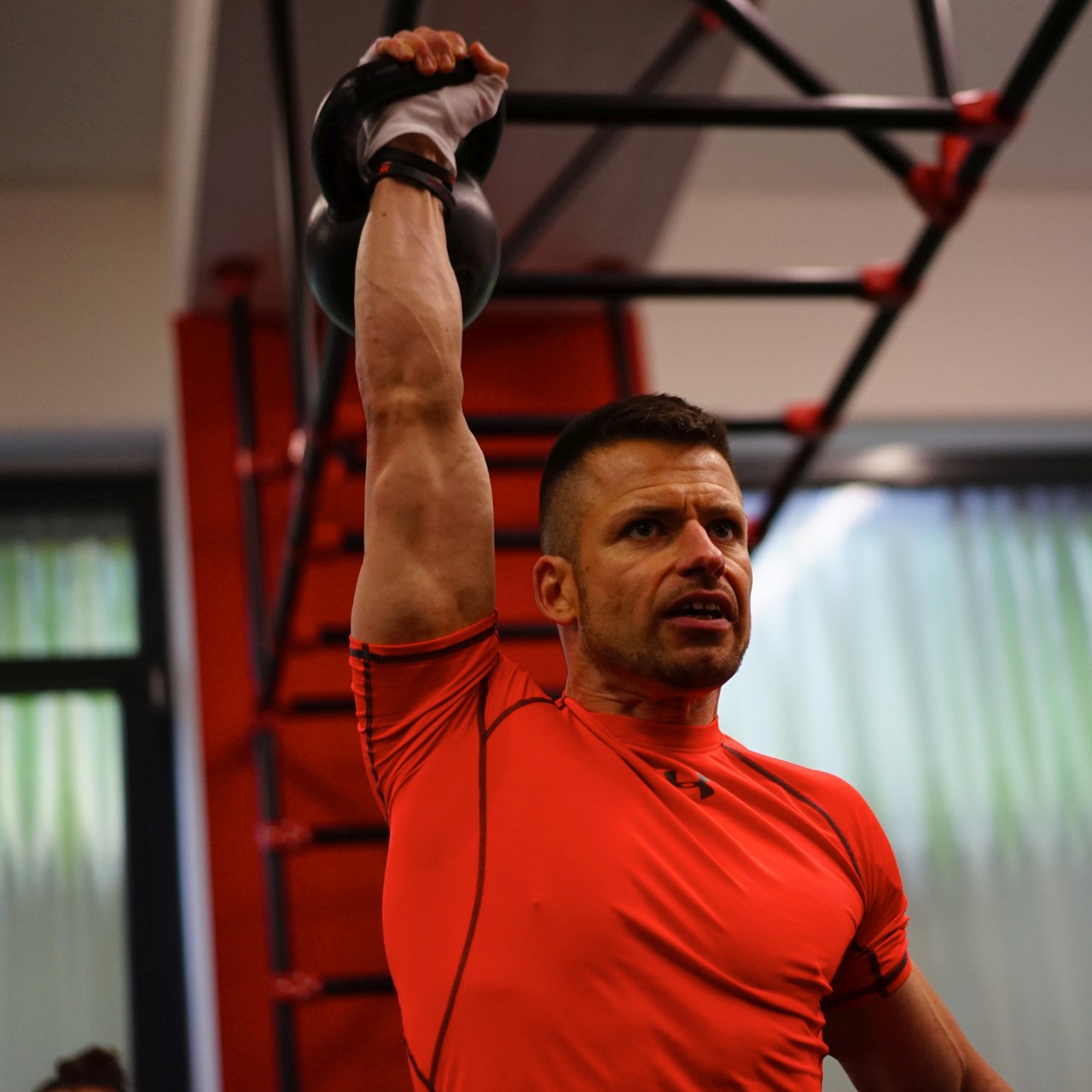
In ballistic kettlebell exercises, we utilize this catapult effect when launching the kettlebell from the hip hinge. With the setup and each subsequent hip hinge, we load the entire posterior muscle chain to release the stored kinetic energy through explosive hip extension and transfer it to the kettlebell. Particularly in hardstyle kettlebell, we further enhance this effect in the counter movement.
By holding the standing plank for as long as possible, we ensure muscle contraction while the kettlebell begins its return journey. Through this muscle tension, we additionally challenge the elasticity of the muscle fascia on its way back before it is once again taken up with the bow tension of the posterior chain and launched. Through many quick repetitions, the myofascia is challenged to adapt to the load and gains both elasticity and strength. The result is more explosive, faster swings. Increasing the weights and stronger tension in the standing plank further improve the fascia, in contrast to classic fascia training, where swinging movements are performed with small weights and corresponding tension. Martina Korte RKC, www.heilmacherin.de