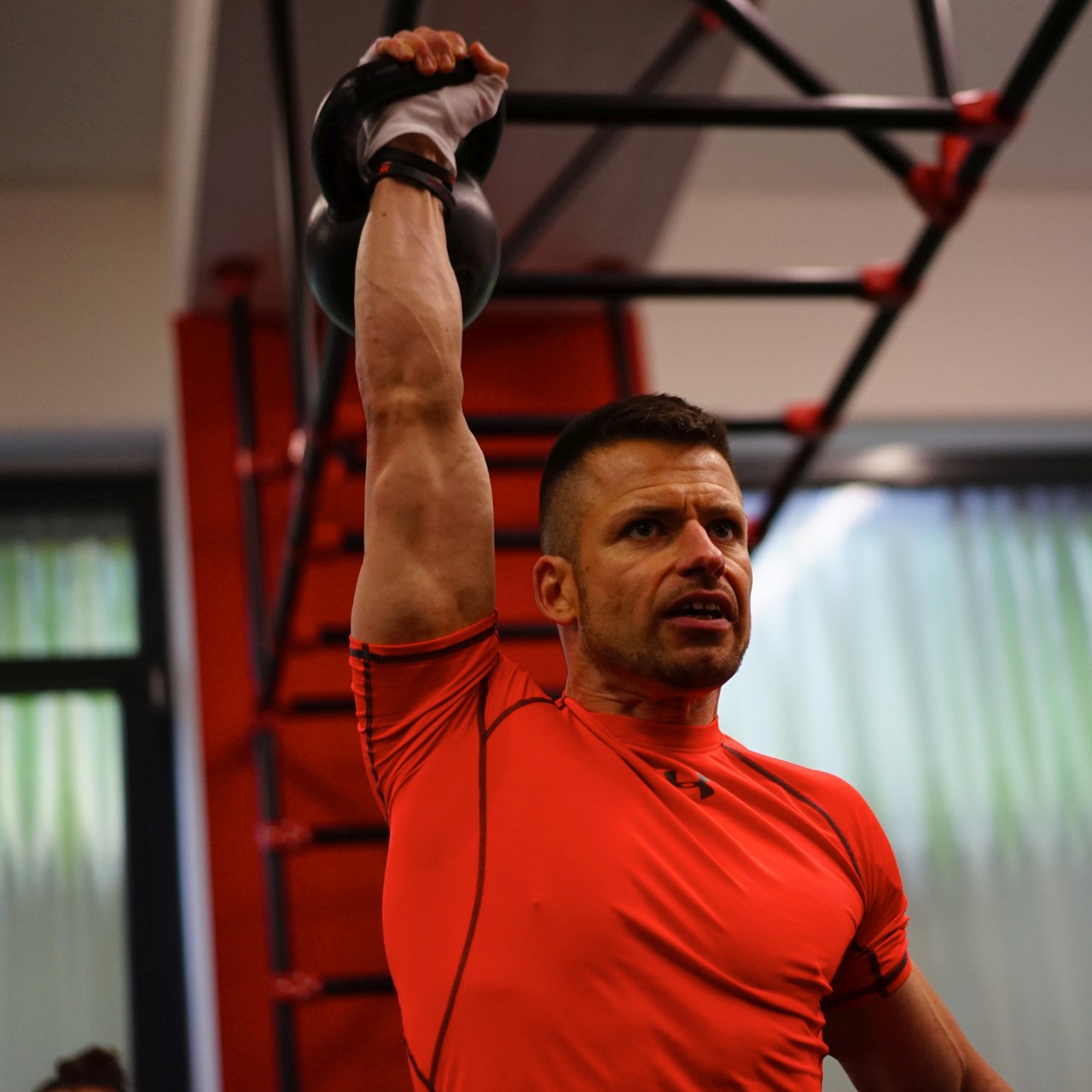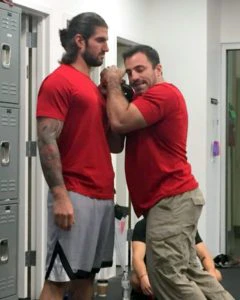
The rack position is a crucial kettlebell skill. Jason Kapnick demonstrates the “loaded clean” to drill lat engagement and rooting to the floor.
It is worth noting that I have not included “kettlebell technique” on this list. While having familiarity and skill with the kettlebell will greatly benefit you throughout the certification weekend, it is not essential to show up with PERFECT skills. The purpose of the course is to teach you these skills, and the master RKCs, team leaders and assistant instructors meet will give you all the coaching you need to pass the rigorous skills tests on the last day of the certification. The amount of progress candidates make during the RKC is nothing short of mind-blowing. So, work on your technique and get comfortable handling kettlebells, but don’t sweat it if you’re not perfect.
This program focuses on Pillars #1 and #2 (strength and work capacity), while also giving you ample time to gain familiarity and exposure to the “Big 6” kettlebell lifts tested at your RKC. While Movement Quality (Pillar #3) is absolutely crucial for success at the RKC, it mostly beyond the scope of this article. I highly recommend finding an FMS certified professional in your area for a movement screen before starting this (or any) program.
This program should be run for 6-10 weeks prior to the certification workshop.
The Program:
Day 1—KB Press & Deadlift
A1. Single Arm Press Ladder (1,2,3,4)x3
A2. (Weighted) Tactical Pull-up 3-5 sets of 5-8 reps
- Deadlift 5,3,2; then drop 20% and 3×5 with 2:00 rest.
- Kettlebell Skill Practice: 10-20 minutes
Press Ladders: Use the classic “Rite of Passage” progression. Add a ladder each week, and then once you get to 5 ladders, start adding rungs to the ladders. Build volume.
Deadlift: In week 1, pick a weight you can perform 8-10 reps with. Perform a set of 5, rest, a set of 3, rest, and then a set of 2, all with that same weight. Then, take 20% of the weight off the bar and do 3 sets of 5 with just a 2:00 rest. Each week, add 5-10lbs per week to the 5,3,2 sets.