RKC KB

This website uses technical and functional cookies so everything works smoothly. If you do not agree to the use of cookies, please do not use this website.

privacy policy

Select your region

Please choose your region to continue.

Oliver Kretschmer HKC |

RKC News - April 2014

The Overhead Walk - valuable but often underestimated -

The Overhead Walk - valuable but often underestimated -

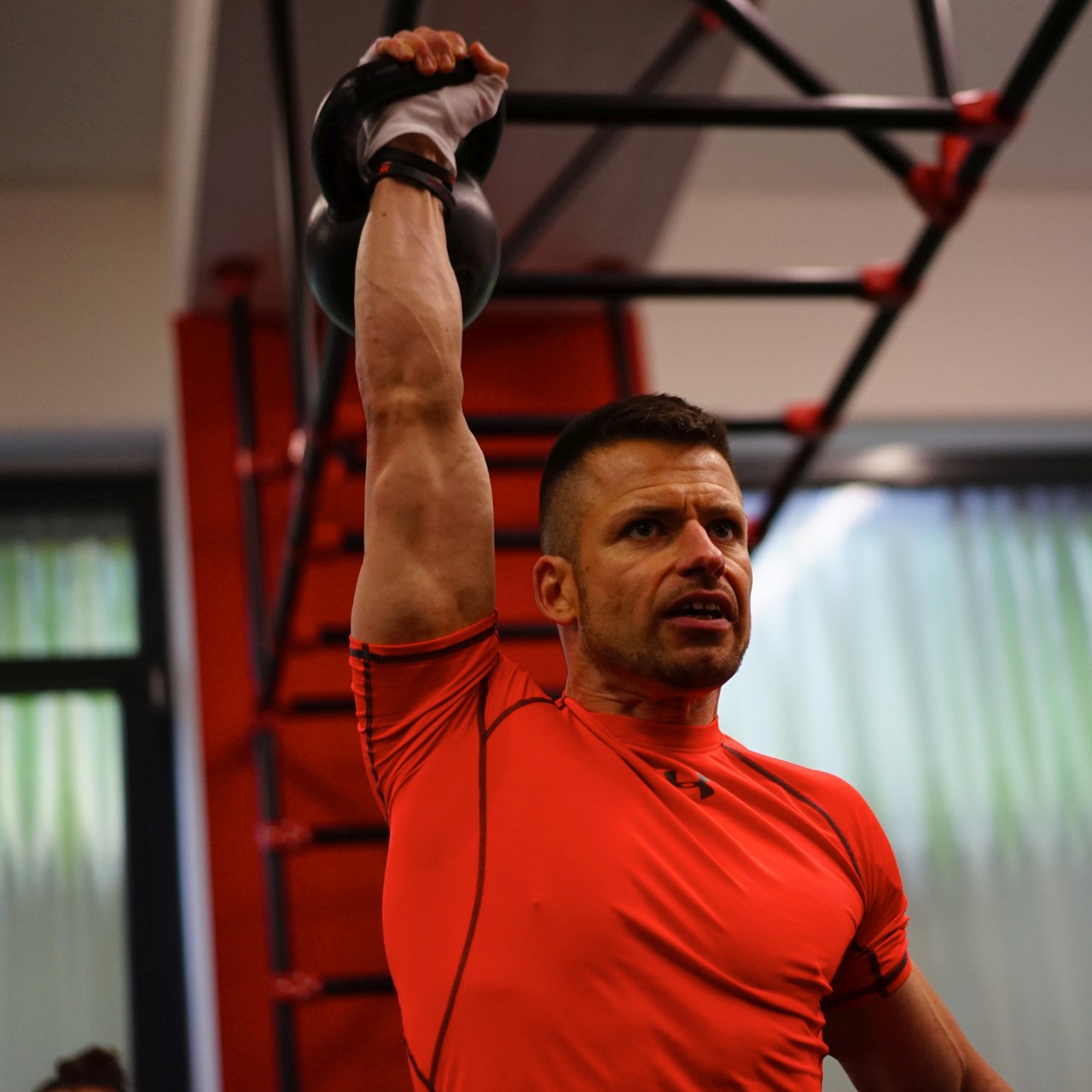
Among kettlebell exercises, there are those that stand out and impress immediately, such as the Snatch or the TGU - and others that offer great potential but seem unremarkable. The Overhead Walk is one of these. Walking around with a kettlebell in an outstretched arm overhead tends to elicit questioning looks. However, both beginners and advanced practitioners benefit from this inconspicuous exercise. Why should this exercise be integrated into the training routine?

First, it is a so-called self-limiting exercise. If there is not enough mobility, it becomes very difficult to perform.

A common problem in our predominantly sedentary society is forward-falling shoulders and a tendency towards a rounded back. The OH Walk can make an important contribution to correcting these postural issues. In addition to centering the joint and improving motor control in the shoulder, it is also an exercise that activates further stabilization patterns throughout the body. The deep stabilizing muscles create an optimized base for absorbing the forces generated by aligning the pelvis and stabilizing the spine. The activation of the anterior "core" through the weight and the corresponding positioning of the ribcage trains the resistance to extension.

Due to the unilateral load, the exercise also presents a significant challenge for rotational control. Therefore, the OH Walk is excellent as a warm-up to prepare the motor system for the demands of Ballistics and Grinds.

Execution: Beginners can bring the kettlebell overhead using the cheat clean, while advanced practitioners can use the Clean and Press. First, one should search for the "sweet spot" (ideal position) while standing and clarify through overhead rotations to each side whether any unwanted tension occurs in the neck. Once that is clarified, the kettlebell can be allowed to "sink" for a moment to improve the shoulder joint position. During this time, one should also focus on body tension and posture. If the position feels stable, one can transition to the first slow steps.

Important: The wrist and elbow are always extended. The abdomen, glutes, and lats are always activated.

Did you know?

... those seeking an alternative way to more stability and strength than the next larger kettlebell will find a good opportunity to progress in the so-called Bottom Up variant or work towards the kettlebell that is 8 kg away – suitable exercises for this include the OH Walk, TGU, and Press.

RKC News April 2014

RKC News April 2014

Download the complete issue as a PDF.

rkcnachrichten_201404.pdf